When you send a message from London to New York, it doesn’t go up to a satellite. It goes down, into the sea. Almost all the data that crosses an ocean travels as pulses of light through glass fibres, each one finer than a human hair, inside cables lying on the seabed. Satellites carry only a tiny fraction.
What’s inside a cable
In the deep ocean, a cable can be surprisingly thin, about the width of a garden hose. At its heart is a handful of optical fibres in a protective tube. Around that is a copper conductor, which carries electrical power out to the repeaters: boxes spaced along the cable that boost the light signal so it can cross thousands of kilometres. Insulation and a tough plastic sheath go round the outside.
Near the shore, where the water is shallow and the dangers are greater, cables are armoured with layers of steel wire. That’s the kind of cable Mara Kell is working on in The First Cut, and it’s much heavier and harder to join.
Why cables break
Cables fail more often than most people imagine. There are well over a hundred faults a year around the world. Most are not dramatic: a fishing trawler drags its gear across the seabed, or a ship drops its anchor in the wrong place. Others come from undersea landslides, earthquakes, or the slow grinding of tide and rock over many years.
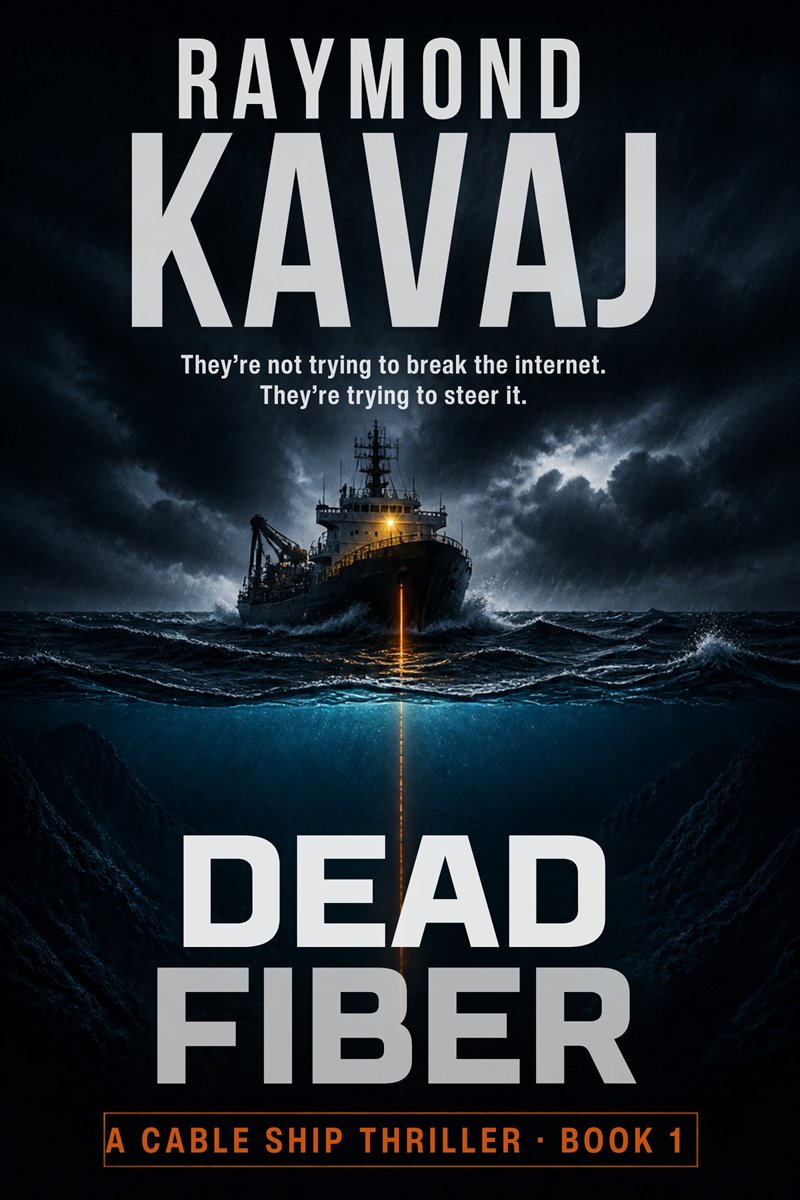
Because there are hundreds of cables, and the internet reroutes traffic automatically when one fails, a single break is usually invisible to ordinary users. The danger is when several fail at once. That is the starting point of Dead Fiber.
Finding the fault
Engineers at the shore stations can work out roughly where the damage is from land. They send test signals down the cable and measure how the light or the electrical current comes back, which can narrow the fault down to a stretch of the seabed many hundreds of kilometres away.
The repair
Then a cable ship goes out. Cable owners share a small fleet of specialist repair ships, kept on standby under maintenance agreements so that one can sail within hours of a fault. A typical repair goes roughly like this:
- Recover the cable. In deep water, the ship drags a grapnel, a kind of hook, along the seabed to catch the cable, or cuts it and lifts each end separately. Underwater robots (ROVs) help in shallower water.
- Cut out the damage and test each end back towards the shore stations to make sure the rest of the cable is healthy.
- Joint in new cable. A jointer splices the fibres one by one, fusing the glass together, then rebuilds the power conductor, insulation and armour inside a joint housing. It can take many hours, and it must be perfect.
- Test it, and then lower the repaired section, the “bight”, back to the seabed, often in weather that is anything but calm.
The whole job can take days, sometimes in the worst weather the North Atlantic can produce. And the crews who do it, the jointers, ROV pilots, bosuns and cooks, are almost unknown outside their industry.
Fiction and fact
The cables, ships and conspiracies in the Cable Ship Thrillers are invented, and the books take some liberties for the sake of the story. But the work is real, and so is the question at the heart of Dead Fiber: what happens when someone decides to control the wire under everything?